


Choosing between a 14kWh vs 28kWh solar battery is not about picking the biggest option. It’s about matching storage to how your home actually uses electricity.
Many Australian homeowners compare sizes without understanding usage patterns, which leads to poor performance or unnecessary cost.
This guide breaks down the real difference, so you can choose what actually works.
14kWh vs 28kWh Solar System Battery: Key Differences Explained
Storage Capacity Comparison
- 14kWh battery → Moderate storage capacity
- 28kWh battery → Double the storage, designed for higher usage
The 14kWh vs 28kWh battery difference is not just size, but how much energy you can actually use effectively.
Daily Usage Coverage
- 14kWh → Covers evening usage for most homes
- 28kWh → Can support extended usage, including overnight or high-demand homes
Ideal Household Types
- 14kWh → Small to medium households
- 28kWh → Large households or high energy users
Basic Cost Difference
- 14kWh → Lower upfront cost
- 28kWh → Higher cost but larger storage capacity
Bigger capacity does not automatically mean better value.
How Much Energy Does an Australian Home Use Daily?
Understanding usage is critical before choosing a battery.
Average Daily Usage (kWh)
State | Avg Daily Usage |
|---|---|
NSW | 8–16–20 kWh |
QLD | 12–18–22 kWh |
SA | 15–20 kWh |
WA | 20–25 kWh |
Consumption Levels
- Low usage → 10–15 kWh/day
- Medium usage → 15–25 kWh/day
- High usage → 25+ kWh/day
Why Usage Matters
If your home doesn’t use enough energy at night, a large battery may remain underutilised.
This is the biggest mistake when comparing 14kWh vs 28kWh solar battery system options.
How Solar System Size Affects Your Battery Choice
The size of your solar system plays a direct role in how effectively your battery performs, yet this is often overlooked when comparing options like a 14kWh vs 28kWh solar system battery.
A battery can only store what your solar panels generate, so if your system is too small, a larger battery may never fully charge. For example, a standard 6.6kW solar system can comfortably support a 14kWh solar battery, as it can replenish that storage on most sunny days.
However, pairing the same system with a 28kWh solar battery often leads to underutilization, especially in winter or during cloudy periods. Larger batteries work best with higher-capacity systems such as 10kW or 13kW, where there is enough excess energy to store.
The key takeaway is that battery size should follow generation capacity. Without proper alignment, even a high-capacity battery can become inefficient and reduce overall system value.
14kWh vs 28kWh Battery Based on Household Size
Small Households (1–2 People)
- Typically, low energy usage
- 14kWh is usually sufficient
Medium Households (3–4 People)
- Moderate usage with appliances and AC
- 14kWh works well, 28kWh only if usage is high
Large Households (5+ People)
- High energy consumption
- 28kWh becomes more practical
Real-Life Examples
- Couple working from home → 14kWh fits
- Family with kids and AC → 14–20kWh range
- Large home with EV + pool → 28kWh makes sense
Return on Investment: Which Battery Gives Better Value?
The return on investment solar battery Australia depends on how efficiently the battery is used.
- 14kWh → Faster payback due to lower cost
- 28kWh → Better for high-usage homes with consistent demand
If the battery isn’t fully used, ROI drops significantly.
In most cases, right-sizing delivers better value than oversizing.
Government Incentives and Rebates Impact
Incentives Overview
The government battery incentives Australia reduce upfront costs, making batteries more accessible.
Does Battery Size Affect Incentives?
- Incentives often apply up to a certain capacity
- Larger batteries may not receive full benefit beyond limits
Battery Size and Incentives
- 14kWh → Often fully aligned with incentive structure
- 28kWh → May exceed optimal incentive thresholds
This impacts overall cost-effectiveness.
Which Solar Battery Size Is Best for Long-Term Planning?
Deciding which solar system battery size is best requires looking beyond your current electricity usage and considering how your needs may evolve over time.
Many homeowners focus only on present consumption, but energy demand often increases with lifestyle changes such as adding electric vehicles, installing more air conditioning, or working from home.
In this context, the 14kWh vs 28kWh solar battery comparison becomes a question of flexibility versus immediate efficiency.
A 14kWh battery is typically sufficient for today’s average household and offers a lower upfront investment with faster returns. However, a 28kWh battery may make sense for households planning significant increases in energy use or aiming for greater independence from the grid.
The smarter approach is to balance current needs with realistic future expectations. In many cases, starting with a right-sized battery and ensuring the system can be expanded later provides the most practical and cost-effective solution.
Common Mistakes When Choosing Between 14kWh vs 28kWh Battery
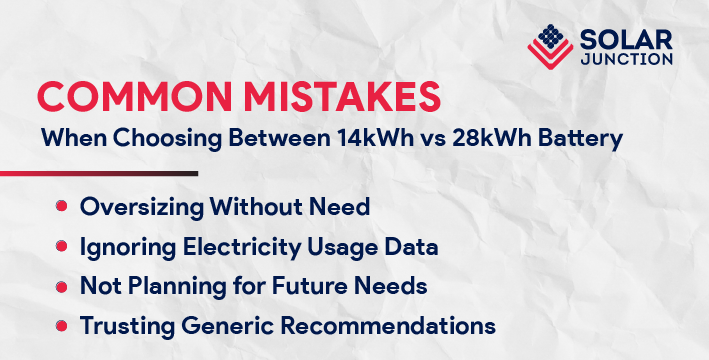
Oversizing Without Need
Buying a large battery without enough usage leads to wasted capacity.
Ignoring Electricity Usage Data
Decisions based on assumptions instead of real consumption data.
Not Planning for Future Needs
Failing to consider EVs, appliances, or growing usage.
Trusting Generic Recommendations
Every home is different. One-size advice doesn’t work.
Can You Upgrade from 14kWh to 28kWh Later?
Yes, in most cases you can expand your battery capacity later.
- Many systems allow modular upgrades
- Compatibility with inverter matters
- Planning ahead reduces future costs
Starting with 14kWh and scaling later is often a smarter approach.

Conclusion
The choice between 14kWh vs 28kWh solar system battery comes down to usage, not size.
- 14kWh suits most Australian homes
- 28kWh is ideal for high-consumption households
The best decision is based on how you use energy, not just how much you can store.