


The changes to Australia’s solar battery rebate programs in May 2026 left many homeowners wondering whether they had missed their opportunity to make battery storage more affordable. Earlier stages of support offered stronger incentives, and the revised structure has created uncertainty for households still considering battery installation.
If you did not apply during the earlier phase, it does not necessarily mean all opportunities are gone. Various support pathways, incentives, and installation options remain available across Australia. The current solar battery rebate Australia landscape, what options are still available, and the practical steps homeowners can take today.
Solar Battery Rebate Current Situation After the May 2026 Change
The May 2026 update changed how battery incentives are calculated and distributed. While the solar battery rebate has not disappeared, support levels have shifted compared to the earlier stages of the program.
What Changed in the Rebate Structure?
The previous phase provided higher levels of support for eligible battery installations. Following the update, incentive values were adjusted, meaning homeowners who delayed installation may receive a lower benefit than those who acted earlier.
Eligibility timelines now play a greater role in determining available support. The households most affected are those that were planning installations before May 2026 but postponed their decision.
What Homeowners Still Have Access To
Despite the changes, several opportunities remain available:
- Ongoing access to qualifying solar battery rebate Australia programs
- Selected state-based battery support schemes
- The federal battery rebate available through approved pathways
- Installation support from accredited providers
Working with qualified installers remains important, as eligibility requirements often depend on approved products and installation standards.
Common Confusion After the Update
Many homeowners mistakenly believe the home battery government rebate ended completely after May 2026. In reality, support structures were revised rather than removed. The amount available may differ, but incentives still exist for many eligible households.
Options Still Available If You Missed the Rebate
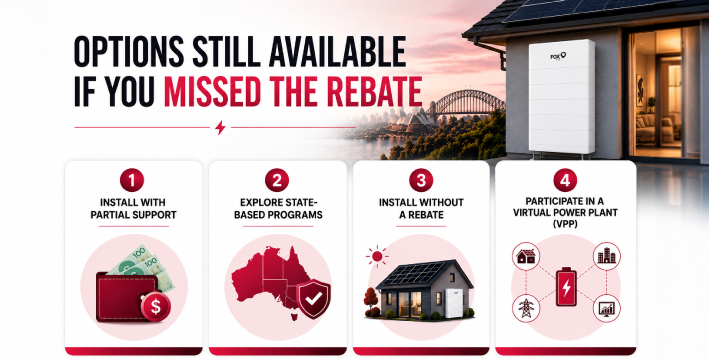
Missing the earlier phase of the solar battery rebate Australia does not leave homeowners without choices.
1: Install with Partial Support
Many households can still access support through the revised federal government solar battery incentive structure. While incentive values may be lower than before, they can still help reduce upfront costs.
2: Explore State-Based Programs
Some states continue to offer local support initiatives that can complement national programs. Depending on location, homeowners may be able to combine eligible programs with broader solar battery incentive opportunities.
3: Install Without a Rebate
For some households, installing a battery remains financially attractive even without incentives. Rising electricity prices and increasing evening energy consumption can still support a reasonable return over time.
4: Participate in a Virtual Power Plant (VPP)
Virtual Power Plants allow eligible battery owners to participate in grid-support programs. In some cases, this can create additional financial benefits that help offset installation costs.
Is Installing a Solar Battery Still Worth It After Rebate Changes?
The value of a battery should not be measured only by the available incentive.
Energy Bill Stability Benefits
A battery allows households to store excess solar energy during the day and use it later when electricity prices are higher.
Benefits include:
- Reduced reliance on peak-period electricity
- Better control over household energy consumption
- Greater flexibility in managing energy costs
As electricity prices continue to fluctuate, many homeowners see batteries as a tool for improving long-term cost predictability.
Long-Term Household Value
A battery can help increase the value of an existing solar investment by improving self-consumption.
Benefits may include:
- Greater energy independence
- Better use of solar generation
- Reduced dependence on grid electricity
- Improved resilience against future tariff changes
The availability of the federal battery rebate can improve the financial case, but long-term usage patterns remain the most important factor, even before home battery government rebate.
Situations Where It Makes Sense
Battery storage may be particularly suitable for:
- Homes with high daytime solar generation
- Households with electric vehicle charging
- Properties with pools or high energy consumption
- Areas experiencing frequent tariff adjustments
In these situations, the revised home battery government rebate may still contribute meaningful value.
How to Plan Your Solar Battery Installation Now?
The best approach is to focus on system suitability before focusing on incentives.
Step 1: Review Your Energy Usage
Understand when your household consumes electricity and how much energy is being exported to the grid.
Step 2: Assess Your Existing Solar System
Determine whether your current system can support battery integration and whether upgrades are required.
Step 3: Compare Available Support
Review the current solar battery rebate Australia options, including state programs and the federal government solar battery incentive pathways available in your area.
Step 4: Choose the Right Battery Size
The largest battery is not always the best choice. Storage should be matched to actual household consumption patterns.
Step 5: Work with an Experienced Installer
Solar Junction helps homeowners evaluate battery compatibility, available incentives, and system sizing requirements. A professional assessment can help ensure you select a solution that aligns with both your energy needs and available support programs.

Conclusion
Missing the earlier stage of the solar battery rebate does not mean battery storage is no longer worth considering. While support levels have changed, opportunities still exist through the federal battery rebate, state programs, and other incentive pathways.
The most important step is understanding how a battery fits your household’s energy usage and long-term goals. For many Australian homeowners, the combination of ongoing federal battery rebate, rising electricity costs, and improved energy control means battery storage remains a practical option well beyond May 2026.