


Quick answer: The Solar Sharer Offer is a new government-regulated electricity plan giving eligible households three hours of free electricity every day in the middle of the day. It’s opt-in, requires a smart meter, and is currently available in New South Wales, South Australia and South East Queensland. You don’t need solar panels to use it, though a home battery is where it tends to pay off the most.
What Is the Solar Sharer Offer?
The Solar Sharer Offer, often shortened to SSO, is a regulated standing offer that started on 1 July 2026. It’s part of a wider set of reforms to the Default Market Offer, the safety-net pricing system that protects households who don’t or can’t shop around for electricity deals.
The Australian Energy Regulator sets the main terms of the SSO, including the free-power window for each area, the daily supply charge and usage rates that apply outside it, and the rate charged if a household goes over the daily free-usage cap (energy.gov.au). Retailers with more than 1,000 customers across the eligible areas are required to offer it, though smaller retailers can be exempt.
It’s worth being clear about what the offer isn’t. It doesn’t make your whole electricity bill free. You’ll still pay a daily supply charge, and anything used outside the three-hour window is billed at standard time-of-use rates, which are sometimes higher on an SSO plan than on a household’s existing plan.
Who Can Get the Solar Sharer Offer?
You can access the Solar Sharer Offer if all of the following apply:
- You’re a residential customer in New South Wales, South Australia or South East Queensland.
- You have a smart meter, sometimes called an interval or digital meter.
- You’re not connected through an embedded network, such as some apartment blocks, caravan parks or retirement villages.
- Your retailer is one of the larger providers required to offer an SSO plan.
The offer is opt-in only. No retailer can move you onto it automatically, and you’ll need to contact your provider directly to switch.
When Does the Free Electricity Period Run?
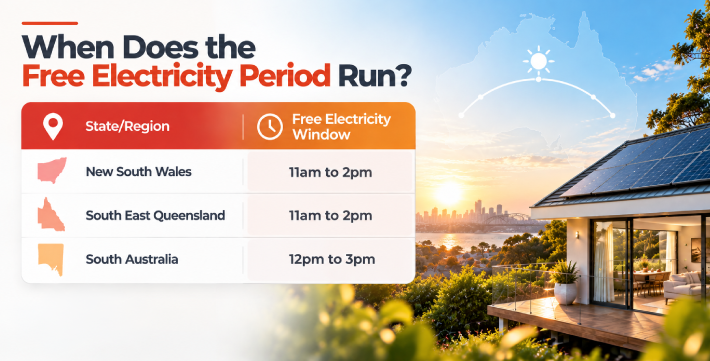
The free period lasts three hours and falls at the same time every day, including through daylight saving. The exact window depends on where you live.
State/Region | Free Electricity Window |
|---|---|
New South Wales | 11am to 2pm |
South East Queensland | 11am to 2pm |
South Australia | 12pm to 3pm |
Households can use up to 24kWh of free electricity during that window each day, which the government estimates covers a full day’s usage for an average five-person household (Energy Made Easy). Anything above that cap is charged at the retailer’s lowest available rate for that time of day.
Solar Sharer Offer vs Feed-in Tariffs: What’s the Difference?
It’s easy to mix these two up, but they sit on opposite sides of your electricity meter. A feed-in tariff is what a retailer pays you for solar electricity you export back to the grid. The Solar Sharer Offer is about what you’re charged when you import power from the grid, and has nothing to do with whether you have solar panels at all.
With feed-in tariffs falling in most states and self-consumption becoming more important for solar households, the Solar Sharer Offer adds a separate lever: rather than being paid for exported power, it’s about timing your usage to avoid paying for power at all during a set window.
Does Having Solar Panels Change Anything?
Not as much as you might expect. If your solar system already covers most of your daytime usage, you’re likely generating your own free power in the middle of the day regardless of whether you’re on an SSO plan. For a lot of existing solar households, switching to the SSO on its own won’t add much.
Where it can still help is on the days your system underperforms, such as heavy cloud cover, or if your household regularly draws more power than your panels produce, for example running a pool pump, ducted air conditioning or an EV charger at the same time. In those cases, the free window gives you a backup source of cheap power instead of drawing from the grid at standard rates.
Where a Home Battery Changes the Numbers
This is where the Solar Sharer Offer becomes genuinely useful for solar households, not just non-solar ones. If you have a solar battery, you can use the free window to top it up, either after your solar has already covered the home’s daytime load, or on lower-generation days when your panels alone wouldn’t fill it. That stored energy can then be drawn down in the evening peak, when grid electricity costs the most.
For households considering adding a battery to an existing solar system or looking at a combined solar and battery package, the Solar Sharer Offer is a genuine reason to run the numbers again. It’s also worth understanding how this interacts with Virtual Power Plant participation, since some VPP arrangements have their own rules about when and how a battery can charge and discharge.
What About Victoria and Other States?
The Solar Sharer Offer itself only applies in NSW, South Australia and South East Queensland, because it’s tied to the federal Default Market Offer system, which doesn’t cover every state.
Victoria is introducing its own separate scheme, the Midday Power Saver, from 1 October 2026, offering a similar three-hour free window between 11am and 2pm (energy.vic.gov.au). It’s a state-based initiative run by the Victorian Government rather than the federal Solar Sharer Offer, so the rules and eligibility criteria differ slightly. The Solar Sharer Offer currently isn’t available in the ACT, Tasmania or Western Australia.
What to Check Before You Opt In
- Confirm your address is in an eligible area and that you have a smart meter installed.
- Ask your current retailer whether they offer an SSO plan, since not every provider does.
- Compare the daily supply charge and the rates outside the free window against your current plan, not just the headline “free” period.
- Check whether hot water systems or pool pumps on a controlled load are excluded, since these are often billed separately.
- Be realistic about how much of your household’s usage you can actually shift into the free window before switching.

Key Takeaways
- The Solar Sharer Offer gives eligible households three hours of free electricity daily, up to 24kWh, in NSW, SA and South East Queensland.
- It’s an opt-in electricity plan, not a solar rebate, and you don’t need solar panels to use it.
- Other charges, including your daily supply charge, still apply.
- Existing solar households may see limited extra benefit unless they add a battery, which can be charged for free during the window and drawn down during the evening peak.
- Victoria’s Midday Power Saver is a separate state scheme starting 1 October 2026, not part of the Solar Sharer Offer.
Want to see more practical solar and energy updates from Solar Junction? Add Solar Junction as a Preferred Source on Google so our latest guides can appear more often in your Google Search experience.
Thinking about pairing a battery with the Solar Sharer Offer? If you’re already on solar and wondering whether a battery would make switching worthwhile, our team can talk through your household’s usage pattern and what a battery could realistically add. Call Solar Junction on 1300 345 365 for a no-obligation chat.