
Can You Add a Battery to an Existing Solar System?
Short answer: yes, in most cases you can add a battery to an existing solar setup.
Longer answer: whether it’s smooth, cost-effective, or even sensible depends on a few technical factors that many homeowners overlook.
If you already have rooftop solar and you’re considering a solar battery system, this blog is worth reading because adding storage is not a plug-and-play decision. Some systems integrate easily, some need upgrades, and a few combinations simply don’t make financial sense.
Understanding what works and what doesn’t will help you avoid wasted money and unrealistic expectations when moving toward a solar system with battery.
When Adding a Battery to Existing Solar Usually Works
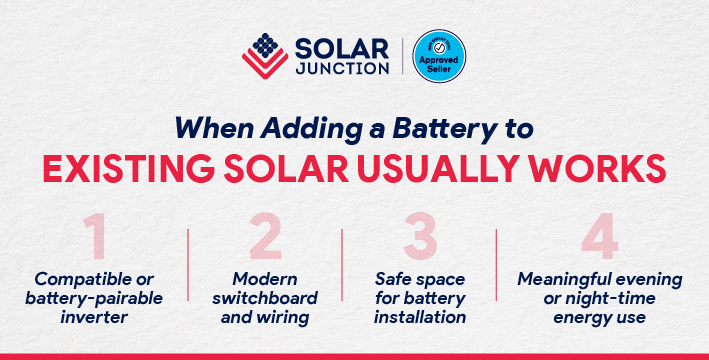
Adding a battery typically works well when your current solar system meets a few baseline conditions:
- Your inverter is compatible or can be paired with a suitable battery type
- Your switchboard and wiring meet modern electrical standards
- You have sufficient space for safe battery installation
- Your energy usage includes meaningful evening or night-time demand
Homes that installed solar within the last 5–7 years usually have fewer obstacles. Older systems can still work, but may require additional upgrades to support a modern solar battery system reliably.
Your Inverter: The Most Important Factor
If solar panels generate energy, the inverter decides how flexible your system is. This is why the inverter is the first thing installers assess when evaluating a solar panel system with battery.
Common Inverter Scenarios
What usually works:
- Hybrid inverters designed to accept batteries directly
- Standard string inverters paired with AC-coupled batteries
- Inverters from major brands that support firmware updates or battery integrations
What usually doesn’t:
- Very old inverters nearing end-of-life
- Proprietary systems locked to discontinued batteries
- Undersized inverters that cannot manage solar, battery, and household load simultaneously
In many cases, you don’t need to replace the inverter entirely. Choosing the right battery architecture can often avoid unnecessary costs.
AC-Coupled vs Hybrid Battery Systems (Simple Comparison)
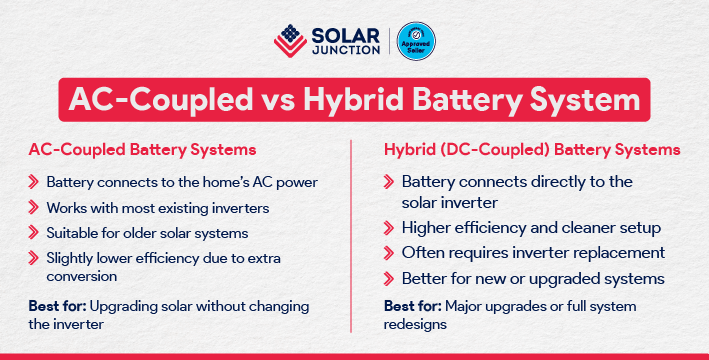
Both AC-coupled and hybrid systems work with existing solar, but the best option depends on your home’s setup, not the battery brand.
AC-Coupled Battery Systems
- Battery connects to the home’s AC side
- Works with almost any existing inverter
- Ideal for retrofitting older solar systems
- Slightly lower round-trip efficiency due to extra energy conversion
Best for: homeowners upgrading an existing solar-only setup without changing their inverter.
Hybrid (DC-Coupled) Battery Systems
- Battery connects directly to the solar inverter
- Higher efficiency and cleaner system design
- Often requires replacing the existing inverter
- Better long-term integration for new installs
Best for: homeowners planning major upgrades or full system redesigns.
Why Solar Panels Are Rarely the Issue
A common misconception is that “old panels won’t work with batteries.” In reality, panels are almost never the limiting factor.
Here’s the correction:
Solar panels simply generate DC electricity. As long as they’re still producing power within expected ranges, they work perfectly with a solar battery system.
Also consider:
- Panel degradation is slow (typically 0.3–0.6% per year)
- Battery performance depends more on inverter control and usage patterns
- Even 8–10-year-old panels can pair effectively with modern storage
In short, if your panels are still generating power, they’re usually not the problem.
Electrical Readiness: Switchboards and Wiring
Why this matters
Batteries introduce higher power flows and new safety requirements. If your electrical infrastructure isn’t ready, installation may be delayed or more expensive.
Key considerations
- Older switchboards may need RCD or circuit upgrades
- Backup-enabled batteries require additional isolation and sub-circuits
- Three-phase homes need careful load balancing
Electrical upgrades aren’t a deal-breaker, but they should be identified early when planning a solar system with battery.
Battery Placement: Where It Works (and Where It Doesn’t)
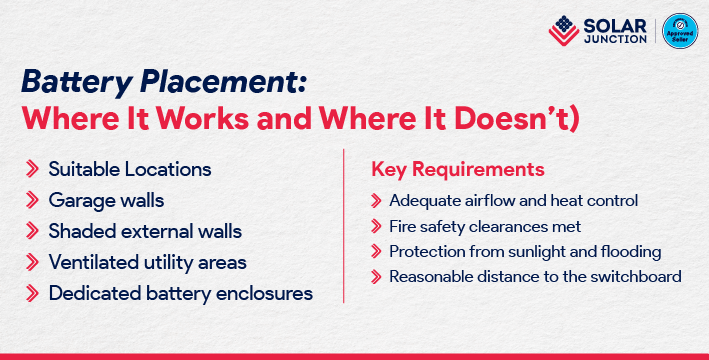
Most homes can accommodate a battery, but not every location is suitable.
Suitable locations
- Garage walls
- External shaded walls
- Utility areas with ventilation
- Dedicated battery enclosures
Key requirements
- Adequate airflow and heat dissipation
- Compliance with fire safety clearances
- Protection from direct sunlight and flooding
- Reasonable cable distance to the switchboard
Placement affects not only safety, but long-term battery lifespan.
Common Myths About Adding Batteries to Existing Solar
- “I need to replace my whole system.”
Usually false. Many upgrades are incremental. - “Batteries only work with new solar.”
Not true. Retrofitting is common and effective. - “A bigger battery always saves more.”
Incorrect. Oversizing often reduces return on investment. - “Batteries eliminate power bills completely.”
Rarely. They reduce bills, but grid reliance still exists for most homes.
Understanding these myths helps set realistic expectations for a solar battery system upgrade.
How to Check If Your Existing Solar System Is Battery-Ready
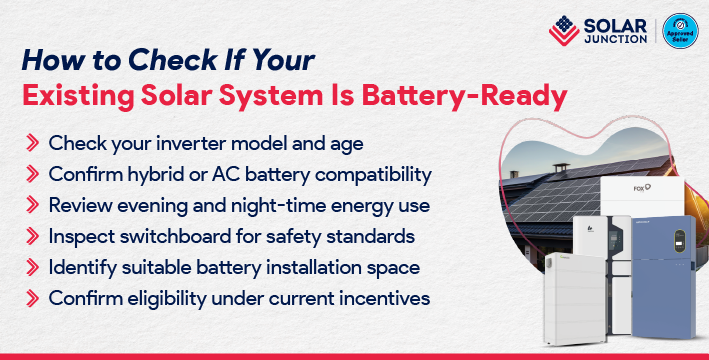
Step-by-step (featured snippet friendly):
- Check your inverter model and age
- Confirm whether it is hybrid-capable or AC-compatible
- Review your evening and night-time energy usage
- Inspect your switchboard for modern safety standards
- Identify suitable battery installation locations
- Confirm eligibility under current incentive programs
This checklist provides a fast way to determine if your home is ready for a solar system with battery.
Backup Mode Vs Self-Consumption Mode: What Most Homeowners Don’t Realise
One overlooked detail when adding a solar battery system to an existing setup is how the battery is programmed to operate. Not all batteries behave the same way, even if the hardware is identical.
Most batteries can be configured in one of two primary modes:
Self-Consumption Optimised Mode
In this mode, the battery focuses on storing excess solar during the day and discharging it in the evening to reduce grid usage. This setup:
- Maximises bill savings
- Works well for homes with high night-time energy use
- Does not always provide blackout protection unless specifically enabled
This is the most common configuration for homeowners adding a battery to an existing solar panel system with battery purely for cost savings.
Backup-Priority Mode
Here, the battery reserves a portion of capacity specifically for outages. This means:
- Some stored energy is “locked away” for emergencies
- Day-to-day bill savings may be slightly lower
- Critical circuits remain powered during blackouts
The key point: backup capability is not automatic. It requires compatible hardware, correct wiring, and intentional system configuration. Many homeowners assume a battery equals backup power, only to discover later that their system was set up purely for self-consumption.
Understanding this distinction early helps avoid disappointment and ensures your solar panel battery system matches your actual priorities; whether that’s savings, security, or a balance of both.
Why Timing Matters: Upcoming Changes to the Cheaper Home Batteries Program
Australia’s Cheaper Home Batteries Program is designed to reduce upfront costs for battery storage, but incentive values are not fixed forever. The program uses certificate-based incentives that step down over time, similar to how solar rebates have historically reduced as adoption grows.
According to Department of Climate Change, Energy, the Environment and Water, the program runs through to 2030, but earlier installations typically receive stronger incentives than later ones. This makes timing an important factor when deciding whether to add a solar battery system now or wait.

FREE Compatibility Check
Not sure whether your existing solar system supports a solar panel battery system?
A quick compatibility check can confirm whether your inverter, wiring, and layout are suitable and whether upgrading now makes sense under current incentives.