

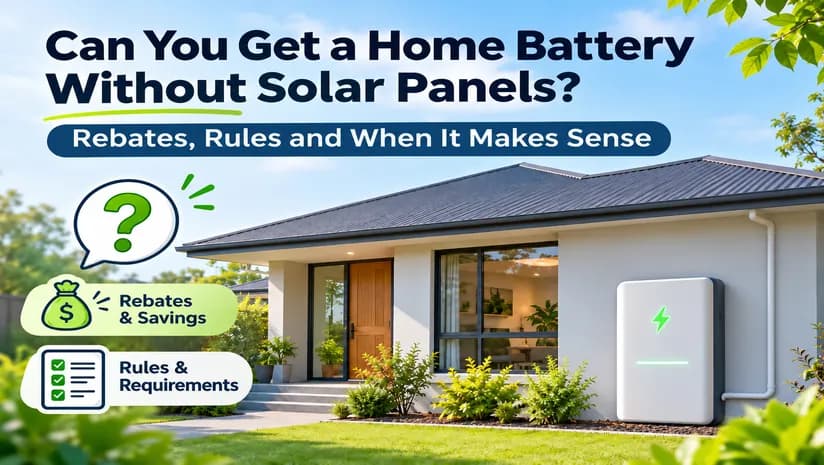
Quick answer: Yes, you can install a home battery without solar panels. The battery charges from the grid instead of your roof, usually when power is cheap or free, and then runs your home later in the day. The catch is the rebate. A home battery without solar does not qualify for the federal Cheaper Home Batteries Program, which only applies when the battery is installed with a new or existing rooftop solar system. Some state incentives work differently, so the right answer depends on where you live, your electricity plan and what you want the battery to do.
How does a home battery work without solar?
A battery-only system stores electricity from the grid. Because there is no solar inverter to connect to, it needs its own battery inverter, which is known as an AC-coupled setup. Most battery-only systems are programmed to:
- charge when grid power is cheapest, such as an off-peak period or a free midday window
- discharge during the evening peak, when import tariffs are usually at their highest
- hold some charge in reserve for outages, if the system has backup hardware
Backup is not automatic. The battery needs a backup-capable inverter or gateway, and most setups cover essential circuits such as lights, the fridge and the internet rather than the whole house. Our guide to AC-coupled and DC-coupled solar batteries explains the hardware differences.
Battery rebate without solar: what the rules say
Federal Cheaper Home Batteries Program
The Clean Energy Regulator (CER) states that solar batteries must be installed with either an existing or new rooftop solar system. Without solar, the battery cannot create small-scale technology certificates (STCs), so there is no federal discount. Other conditions include:
- nominal capacity between 5 kWh and 100 kWh, with STCs only created on the first 50 kWh of usable capacity
- a battery on the Clean Energy Council approved battery list
- installation by a Solar Accreditation Australia accredited installer with a battery endorsement
- for grid-connected systems, a battery that is technically capable of joining a virtual power plant (VPP)
A battery without solar may still attract state support in NSW and possibly WA, but not the federal discount.
What you give up without solar: a worked example
The federal discount is calculated in STCs. For batteries installed between 1 May and 31 December 2026, the STC factor is 6.8 per kWh of usable capacity for the first 14 kWh, with lower rates above that. A battery with 10 kWh of usable capacity would create 68 STCs if installed with solar. From 1 January 2027 the factor drops to 5.7, or 57 STCs for the same battery.
The dollar value depends on the STC price your installer receives, which moves with the market. A battery-only install gives up that whole amount. Our article on federal battery rebate changes from January 2027 sets out the full schedule.
Can you install the battery now and add solar later?
You can, but it will probably cost you the rebate. Under CER rules, an eligible battery must be new, must not have been installed before, and must be installed with solar. A battery that goes in first without solar is unlikely to qualify once panels are added later. If solar is part of your plans in the next year or two, installing both together usually gives the better result. Our solar panel and battery packages show the options.
If you already have panels, see our guide to adding a battery to an existing solar system instead.
When a home battery without solar makes sense
A battery-only system can be a fair choice in a few situations:
- Your roof can't take solar. Heavy shading, a poor orientation, heritage controls or strata rules can rule panels out.
- You're on the Solar Sharer Offer. Since 1 July 2026, households with a smart meter in NSW, South East Queensland and South Australia can choose a plan with three free hours of electricity each day. The window is 11am to 2pm in NSW and South East Queensland, and 12pm to 3pm in South Australia, capped at 24 kWh. A battery can charge in that window and run the house through the evening. Our Solar Sharer Offer explainer covers how the plan works.
- You're on a time-of-use tariff with a big gap between off-peak and peak rates. Charging cheap and using that power at peak can cut your bill, depending on the price gap and battery losses.
- Outages are common where you live. A backup-capable battery can keep essentials running.
- You live in NSW and want VPP payments. The NSW VPP incentive does not list solar as a requirement.
When it usually doesn't
- Your roof is suitable for solar. Pairing the two gives you your own generation and the federal discount.
- You're on a flat-rate plan with no cheap or free window. There is little price difference for the battery to work with.
- The Solar Sharer Offer isn't available in your area. It currently applies only in NSW, South East Queensland and South Australia.
- You expect the battery to wipe out your bill. Daily supply charges still apply, and savings depend on your usage and tariff.

Checklist before you decide
- Check your roof. Can it take solar now or in the next couple of years?
- Check your electricity plan. Is there a free or cheap window, and how high is the evening peak rate?
- Confirm which incentives apply in your state on the official government pages.
- Decide whether you need backup and which circuits it should cover.
- Size the battery to your evening use, not the biggest battery you can afford. Our solar battery size guide can help.
- Get a written quote that shows every discount, the usable capacity and the installer's accreditation.