

Quick answer
Bifacial solar panels make power from both sides, but the back only adds useful output when reflected light can reach it. On a typical home, with panels mounted close to a darker pitched roof, the extra yield is small. They make more sense on tilt frames over light-coloured flat roofs, carports and pergolas.
Bifacial solar panels are standard on solar farms, and more installers now quote them for homes. The real question is whether the back of the panel will make enough extra power on your roof to justify any price difference. That comes down to roof colour, roof pitch and how high the panels sit.
What is a bifacial solar panel?
A bifacial solar panel has cells that can absorb light on both faces. A standard monofacial panel has an opaque back sheet, so only the front produces power. A bifacial panel replaces that back sheet with clear glass or a transparent rear layer, so light bouncing off the surface below can reach the back of the cells.
Many bifacial panels are dual-glass N-type modules, built with the same monocrystalline cell technology as standard panels. Manufacturer datasheets for current dual-glass ranges from Jinko and Trina list a bifaciality of about 80%, meaning the rear produces roughly 80% of what the front would under identical light. The catch is that on a roof, the rear almost never gets identical light.
| Feature | Monofacial panel | Bifacial panel |
|---|---|---|
| Rear side | Opaque back sheet, no output | Glass or clear layer, generates power |
| Typical build | Glass front, polymer back | Glass on both sides |
| Wattage on the label | Front-side rating | Front-side rating, rear gain listed separately |
| Best mounting | Flush on pitched roofs | Raised frames over light surfaces |
How much extra power do bifacial panels make on a roof?
On a standard home roof, the extra output from the rear side is usually modest because the back of the panel faces a dark surface only a short distance away. Industry estimates for flush-mounted panels on dark pitched roofs tend to sit in the low single digits, though every site differs.
Three factors set the gain:
- Roof colour. Light surfaces reflect more sunlight onto the rear. Charcoal tiles, terracotta and dark metal roofing reflect very little.
- Gap under the panel. Standard rails hold panels close to the roof, often around 10 to 15 cm, which leaves little room for reflected light to reach the back.
- Tilt and shading. Rails, roof structure and neighbouring panels all shade the rear side.
Australian research supports this. A 2023 modelling study from the Australian National University found bifacial panels on flat rooftops could produce up to 22.6% more energy than monofacial panels. That result assumed a highly reflective roof and tilted frames, with bifacial panels in the Canberra modelling doing best at about 45° of tilt versus roughly 35° for standard panels. It is a best case for a bright, flat roof, not a typical tiled house.
Datasheets reflect this too: the headline wattage is the front-side rating, with rear-side gains listed separately. Check which figure each quote uses.
When a bifacial solar panel on a roof makes sense
They work best when the rear side has light and space:
- Flat roofs with tilt frames over a light-coloured membrane or pale metal roofing
- Carports, pergolas and sheds or garages where the panels form the roof and the ground below is pale concrete or paving
- Ground-mounted arrays on larger blocks
- Flat commercial solar roofs with clearance under the racking
They add little on pitched roofs in dark colours, on dark Colorbond with standard rails, or where trees and nearby buildings already cut output. Our guides to solar for different roof types and solar panel shading cover those situations in more detail.
Disadvantages of bifacial solar panels for homes
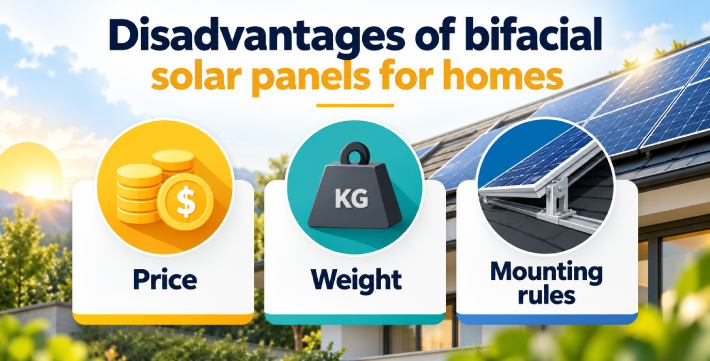
- Price. Pricing varies by brand, model and supply, so ask for a bifacial and an equivalent monofacial panel quoted side by side.
- Weight. Dual-glass panels can weigh more than glass-back sheet panels of a similar size. Your installer should check the datasheet weight against your roof structure and warranty conditions.
- Mounting rules. Some bifacial models are frameless or have set clamping zones. Installers must follow the manufacturer's mounting instructions to keep the warranty valid.
On the plus side, the dual-glass build is tough, and some manufacturers back these models with long performance warranties. Compare the product and performance warranty terms, not just the wattage.
Are bifacial panels worth it for Australian homes?
For most Australian homes with pitched, dark roofs, bifacial solar panels are worth choosing only when the price is close to a comparable monofacial panel. Don't pay a large premium expecting big extra output. On a fixed budget, a slightly larger system, such as moving from a 6.6kW system to a 10kW system, or adding a solar battery, may do more for your bills.
Rebate eligibility works the same way as for any other panel. Only modules on the Clean Energy Council's approved PV modules list can create small-scale technology certificates, so check the exact model number in your quote. Our STC rebate guide explains how the discount is calculated.
Checklist: questions to ask before choosing bifacial panels
- What colour and material is my roof, and how much light does it reflect?
- How far above the roof will the panels sit?
- Is the exact model on the CEC approved modules list?
- Is the quoted wattage the front-side rating?
- What is the price difference compared with an equivalent monofacial panel?
- Can my roof structure carry the panel weight?
- What do the product and performance warranties cover?

Key takeaways
- Bifacial panels generate from both sides, but the rear needs reflected light and space to help.
- On flush-mounted, dark pitched roofs, the extra output is usually small.
- Flat roofs with tilt frames, carports and pergolas over pale surfaces are a better fit. Compare quotes like for like.
We update guides like this as products and rules change. To see them more often in Google's Top Stories and AI results, add Solar Junction as a preferred source on Google.