
The solar industry has witnessed significant advancements in recent years, with half cut solar cells emerging as a revolutionary technology. As homeowners increasingly seek the most effective solar system, half-cut solar panels are becoming a preferred choice due to their enhanced performance and durability.
In this article, we'll explore what half-cut solar cells are, their advantages over traditional full-cell panels, and why they are a smart choice for your home.
What Are Half-Cut Solar Cells?
Half-cut solar cells are exactly what their name suggests—solar cells that are cut in half. Unlike traditional full-cell panels, where solar cells are kept intact, half-cut cells are sliced into two equal parts. This innovation reduces the electrical resistance within the panel, leading to improved efficiency and performance.
These panels are often designed with advanced technologies like mono half cut solar panels and half-cut mono PERC solar panels, making them ideal for modern solar systems.
How Do Half-Cut Solar Cells Work?
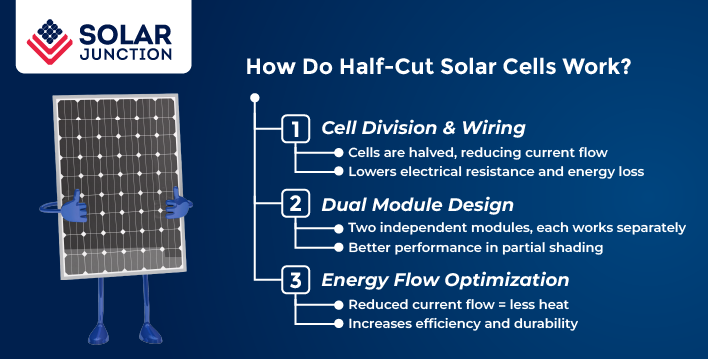
Half-cut solar cells work by dividing a traditional solar cell into two smaller units, which effectively changes how electricity flows through the panel. Here's how the technology operates:
1. Cell Division and Wiring Configuration
A standard solar panel is wired into rows and columns of cells, forming an electrical circuit. When cells are cut in half, the current produced by each cell is also halved, which reduces electrical resistance and energy loss during transmission.
2. Dual Module Design:
Half-cut panels are typically divided into two independent modules. Each module operates separately, so if one side of the panel is shaded, the other side continues to generate power.
This ensures better performance under partial shading conditions compared to traditional full-cell panels.
3. Energy Flow Optimization:
Halving the cells reduces the heat generated within the panel, as lower current flow minimizes resistive losses. This not only improves the panel's efficiency but also enhances its durability over time.
By implementing these design improvements, half cut solar cells achieve higher energy production and efficiency, making them a critical component in the most efficient solar system.
Half Cut Solar Panel vs Full Cell: Key Differences
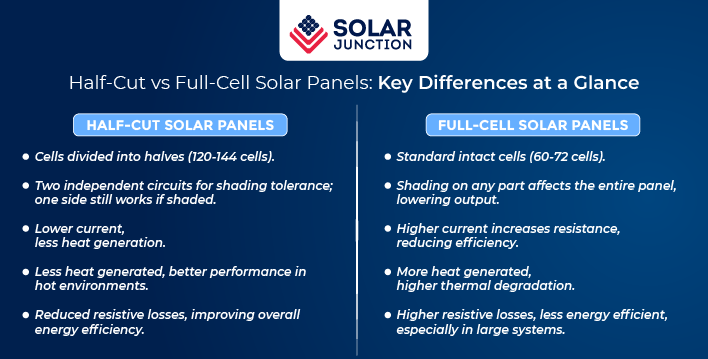
When comparing half-cut solar panels to traditional full-cell panels, the distinctions lie in their design, electrical configuration, and operational mechanics. These technical differences play a crucial role in their performance, efficiency, and durability.
1. Cell Design and Structure
- Half-Cut Solar Panels:
In half-cut panels, the standard solar cells are physically cut into two equal halves. This creates smaller cells that reduce the amount of current each cell handles, resulting in lower resistance and heat generation.
Typically, a half-cut panel contains 120 or 144 cells instead of the 60 or 72 cells found in full-cell panels. - Full-Cut Solar Panels:
Full-cut panels use standard, intact solar cells. These larger cells handle higher currents, which can lead to increased electrical resistance and heat losses compared to half-cut cells.
2. Current Flow
- Half-Cut Panels:
The current produced by each cell is halved due to the smaller size of the cells. This lower current reduces resistive losses within the panel, improving energy efficiency. The reduced heat also minimizes thermal stress, extending the lifespan of the panel. - Full-Cut Panels:
Full-cut cells produce a higher current due to their larger size. While this enables simpler circuit design, it also results in greater resistive losses, reducing overall efficiency.
3. Circuit Configuration
- Half-Cut Panels:
These panels are divided into two separate circuits, effectively forming two independent modules within a single panel.
This design allows one side of the panel to continue functioning even if the other side is shaded or obstructed. The wiring layout is also optimized to handle the reduced current efficiently. - Full-Cut Panels:
Full-cell panels operate as a single circuit. If shading occurs on even a small portion of the panel, the performance of the entire circuit is affected, significantly reducing energy output.
4. Heat Management
- Half-Cut Panels:
The smaller cells in half-cut panels generate less heat due to reduced current flow. This helps in maintaining the panel's efficiency and reliability, particularly in high-temperature environments. - Full-Cut Panels:
Full-cell panels generate more heat as the larger cells handle higher currents. Over time, this increased heat can lead to thermal degradation, reducing panel performance and lifespan.
5. Shading Impact
- Half-Cut Panels:
The dual-module design of half-cut panels minimizes the impact of shading. If one module is shaded, the other can continue producing electricity, ensuring higher energy output in partially shaded conditions. - Full-Cut Panels:
In full-cell panels, shading on any part of the panel can disrupt the entire circuit, leading to a significant drop in energy production.
6. Energy Efficiency
- Half-Cut Panels:
The reduced electrical resistance in half-cut panels improves their energy efficiency. This is particularly beneficial in larger installations where resistive losses can accumulate. - Full-Cut Panels:
Full-cell panels are generally less efficient due to higher resistive losses, which become more noticeable in systems with higher power outputs.
7. Mechanical Durability
- Half-Cut Panels:
Smaller cells experience less mechanical stress, making them less susceptible to micro-cracks caused by thermal cycling or external pressures. This enhances the overall durability and reliability of half-cut panels. - Full-Cut Panels:
Larger cells in full-cut panels are more prone to micro-cracks, which can develop over time due to thermal expansion or mechanical strain.
Half-Cut Solar Panel Benefits
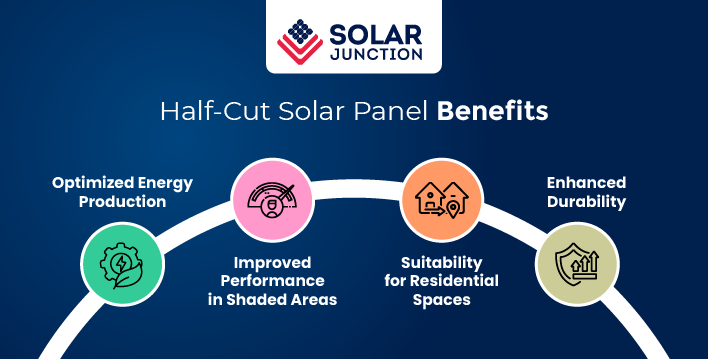
Opting for half cut solar cells offers numerous advantages, including:
- Optimized Energy Production: The reduced resistance in half-cut cells ensures maximum energy conversion, especially under high solar exposure.
- Improved Performance in Shaded Areas: Partial shading is a common issue in residential settings due to trees or neighboring buildings. Half-cut panels perform better under such conditions, ensuring consistent power output.
- Enhanced Durability: With reduced stress on individual cells, these panels are more resistant to cracking and other forms of wear and tear, making them a cost-effective solution.
- Suitability for Residential Spaces: Whether you have limited roof space or challenging shading conditions, half-cut panels are versatile and adaptable, making them a perfect fit for most homes.
These half cut solar panel benefits position them as a leading choice for homeowners seeking the most efficient solar system.
Why Choose Mono Half-Cut Solar Panels?
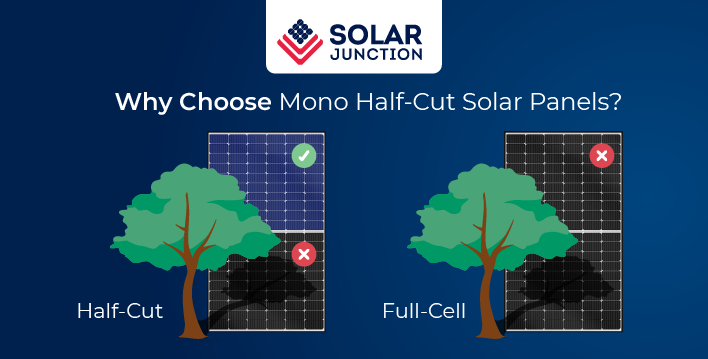
Mono half-cut solar panels combine the efficiency of monocrystalline cells with the advanced design of half-cut technology. These panels are crafted to deliver exceptional performance, particularly in environments with fluctuating sunlight conditions.
- High Productivity: Monocrystalline cells are already known for their high efficiency, and when paired with half-cut technology, the result is an ultra-efficient solar panel.
- Compact Design: Ideal for smaller rooftops, mono half-cut solar panels maximize energy production in a limited space.
- Longevity: These panels are designed to withstand harsh weather conditions and maintain high performance over their lifespan.
For homeowners aiming to install the most effective solar system, mono half-cut solar panels represent a premium option that balances performance and durability.
Are Half-Cut Solar Panels the Best Choice for Your Home?
Incorporating half-cut solar cells into your residential solar system is an excellent way to boost energy efficiency and long-term savings. With reduced resistance, better shading tolerance, and higher durability, these panels are a top choice for homeowners who want the most resourceful solar system.
At Solar Junction, we specialize in advanced solar technologies, including mono half-cut solar panels and half cut mono PERC solar panels. Our expert team can help you design a solar system that meets your energy needs and budget while maximizing your return on investment.

Conclusion
The introduction of half cut solar cells has revolutionized the solar industry, offering homeowners a more efficient and reliable alternative to traditional panels. Whether you're looking for better energy production, improved shading tolerance, or long-lasting durability, half cut solar panels are the ultimate choice for modern residential solar systems.
Investing in advanced technologies like mono half cut solar panels or a half-cut mono PERC solar panel ensures that your home benefits from the latest in solar innovation.
Contact Solar Junction today to explore how our systems can provide you with the most efficient solar system tailored to your needs. Together, let's build a greener and more sustainable future!