Massive Battery Savings Have Landed Claim Yours Today!

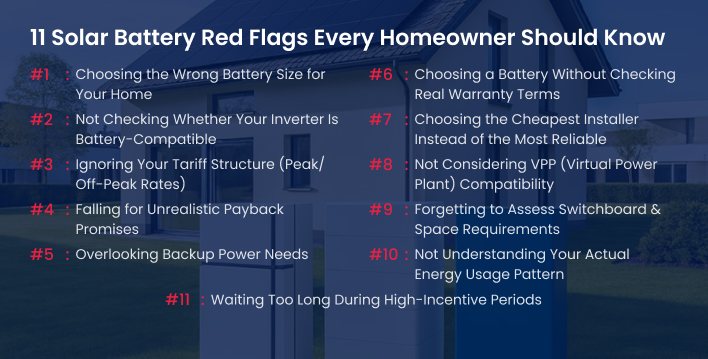
Top Mistakes to Avoid When Buying a Solar Battery System
HOME > Top Mistakes to Avoid When Buying a Solar Battery System


Buying a solar battery system is exciting, finally taking control of your energy bills, preparing for outages, and making the most of your solar. But here’s the truth: one wrong decision can cost you thousands over the battery’s lifetime. And in 2025, mistakes are more common than ever due to high demand, installer shortages, and the rush created by new incentive such as the federal home battery program.
This guide breaks down the most expensive mistakes homeowners make, how to avoid them, and a simple checklist you can use before buying any battery.
Many homeowners either overspend on a battery that’s too large or buy one too small to cover their nightly usage. A properly sized solar battery storage system should match your home’s consumption patterns, not just your solar output.
If your battery empties too quickly or stays full all day without cycling, your return on investment suffers. Always size based on usable capacity and actual consumption, not marketing claims.
This is one of the biggest hidden costs.
Hybrid vs Non-Hybrid Explained Simply
Three scenarios:
Cost Impact
A surprise inverter replacement can add to your project,avoid this by checking compatibility during the quote stage.
Your utility tariff determines how much a battery can save you. Households on time-of-use tariffs benefit the most because batteries offset expensive peak rates.
If your installer doesn’t ask about your tariff, that’s a red flag. Your battery savings depend heavily on when your home uses power, not just how much.
Some sales reps promise paybacks that simply aren’t possible.
Red Flags:
What’s realistic?
For most Australian homes:
(faster with the federal home battery program or VPP bonuses)
Always calculate ROI based on:
Not all batteries in solar battery system provide backup power, this surprises a lot of homeowners.
Two types of batteries:
If backup matters to you, confirm:
Your air conditioner, oven, pool pump, or EV charger may not run during a blackout without a correctly sized system.
A long warranty isn’t enough, most people never read the fine print.
Check these 4 clauses carefully:
A cheap battery with a weak warranty usually ends up being the most expensive.
Low-cost quotes often leave out:
A poor installation can cost you far more in repairs, failed inspections, and lost performance.
Always choose a Clean Energy Council–accredited installer with strong reviews and transparent pricing.
A surprising number of homeowners buy batteries that cannot join a VPP.
Considering VPPs offer:
It makes sense to choose a VPP-compatible battery from day one. Many leading brands include VPP-ready hardware; verify before purchasing.
Most homes need at least some level of switchboard work before installing a battery. Many older houses require:
Outdoor installation also requires weather protection, IP-rated enclosures or shaded mounts.
Your evening and night-time usage determines solar battery system value more than anything else. A battery is less effective if your home barely uses power at night.
Usage patterns matter more than solar size.
The federal home battery program is driving rapid demand, and with it:
Delaying can risk losing eligibility or paying higher prices later.
Lock in your installation early to secure both incentives and stock allocation.

Avoid the costly mistakes that most homeowners make.
Book your free solar battery assessment with Solar Junction today.
Yes, especially under the 2025 federal home battery program. Savings improve dramatically for households with high evening usage or time-of-use tariffs.
General guideline:
Only if your inverter is not hybrid-compatible. Otherwise, AC-coupled batteries also work with non-hybrid systems.
No. Some provide zero backup protection. Always check backup-capable vs non-backup models.
Most last 10–15 years, depending on cycle count and degradation.
Yes. Both programs work independently, and you can stack benefits.
Not fully, but it can reduce your bill significantly, especially with solar + TOU tariff optimisation.
Many systems allow expansion, check brand compatibility and inverter capacity.
Yes, but wiring, backup ability, and charger support need professional assessment.
It simply charges less. The system automatically prioritises essential loads.
Yes, many are IP-rated for outdoor use with proper shading and ventilation.
Rushing into a purchase without checking inverter compatibility, warranty terms, and actual energy usage patterns.

Higher rebates available
only until 30 April 2026