

Short answer: a solar battery in 2026 can make sense for some households.
Equally important: it is not an automatic upgrade for every solar home.
“Consider” is the right word here. Batteries are no longer niche, but they are also not a universal fix. This guide is designed to help homeowners assess fit rather than follow trends. You’ll learn how real-world usage, existing system setup, timing, and expectations come together to determine whether a solar system with battery is the right move for you in 2026.
Why Solar Batteries Are Being Considered More Often Now
Rooftop solar is already widespread across Australia. In many suburbs, it’s the default energy upgrade rather than an exception. As a result, homeowners are increasingly asking the next question: what happens after solar is installed?
Battery storage is now viewed as a second-stage decision rather than a starting point. In 2026, this reflects a more mature phase of adoption where households with rooftop solar with battery options are weighing storage based on lifestyle and usage, not novelty.
Installation data published by the Clean Energy Regulator shows continued growth in battery uptake alongside solar, but at a different pace. That divergence matters. It suggests growing interest without implying universal suitability.
What Australian Installation Data Can (and Can’t) Tell You
National data indicates solar system with battery installations are increasing faster than solar-only systems. That points to momentum, confidence, and falling barriers. What it does not tell you is whether a battery is right for your home.
Data can show trends, not outcomes. Two households in the same postcode can have opposite results from the same battery size due to different routines. This is why household-level assessment matters more than national averages when considering an existing solar system battery.
How Household Energy Use Shapes the Decision
Timing matters more than totals.
If most of your electricity use happens after sunset cooking, heating or cooling, entertainment storage may meaningfully increase self-use of solar. If your usage is primarily daytime (home office, daytime appliances), a battery may cycle less often and deliver smaller benefits.
This shift explains why exporting excess solar is no longer the main consideration for many homes. The focus has moved to self-consumption alignment using what you generate, when you need it, without turning it into a technical exercise.
Government guidance on household solar and storage reinforces this point: usage patterns, not just system size, determine outcomes.
What a Solar Battery Will Change in Your Home - and What It Won’t
A solar battery can influence:
- How excess rooftop solar is stored rather than exported
- How electricity is accessed after sunset
- How solar generation aligns with daily routines
A solar battery does not change:
- How much energy your panels produce
- Your household’s electricity habits
- Your connection to the electricity grid
This expectation-setting is critical. Adding storage doesn’t magically increase generation or eliminate grid reliance. It simply shifts when your solar energy is used.
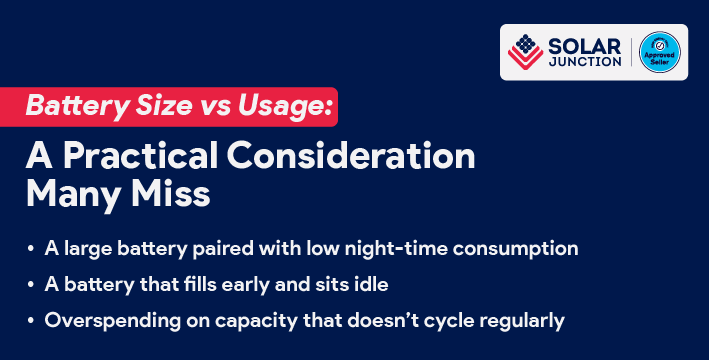
Battery Size vs Usage: A Practical Consideration Many Miss
Capacity alone doesn’t determine suitability.
A larger battery can store more energy, but if your evening usage is modest, much of that capacity may go unused. Common mismatch scenarios include:
- A large battery paired with low night-time consumption
- A battery that fills early and sits idle
- Overspending on capacity that doesn’t cycle regularly
A better approach is right-fit storage. Instead of “bigger is better,” the goal is a battery that charges and discharges consistently in line with how your household actually operates.
Should You Add More Panels or Consider a Battery Instead?
Panels and batteries do different jobs.
- Adding panels increases generation
- Adding a battery changes when solar energy is used
For homes with existing solar, adding more panels often increases exports rather than usable energy. In 2026, batteries are commonly considered as a next step once generation is already adequate.
This is especially true when households are already exporting surplus power during the day but buying electricity back in the evening.
Timing Considerations in 2026: What Homeowners Should Be Aware Of
Battery-related programs and policy settings evolve over time. From 1 May 2026, changes to how support is calculated are scheduled under the Cheaper Home Batteries framework administered by the Department of Climate Change, Energy, the Environment and Water.
Timing provides context, not a decision override. Incentives can influence cost, but they do not fix technical mismatches or unsuitable usage patterns. System readiness should always come first; timing should follow, not lead.

Bringing It Together: Should You Consider a Solar Battery in 2026?
A solar battery in 2026 is:
- Increasingly common
- More accessible than in earlier years
- Still not compulsory
The decision comes down to context:
- Energy usage patterns (especially evenings)
- Existing solar system setup and inverter compatibility
- Household goals, such as bill smoothing or future plans
For some homes, adding battery to Existing solar system makes practical sense. For others, optimising usage or system configuration may deliver similar benefits without storage.
The best decision is informed, specific, and personal—not trend-based.