
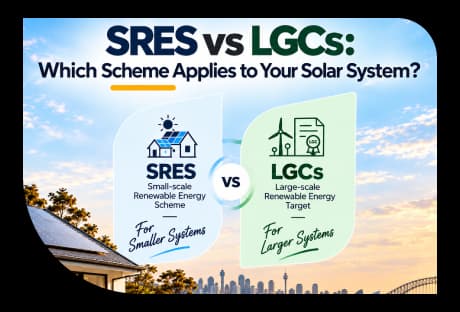
Quick answer: A solar system under 100kW usually falls under the Small-scale Renewable Energy Scheme (SRES) and earns Small-scale Technology Certificates (STCs) upfront. A system of 100kW or more currently sits under the Large-scale Renewable Energy Target (LRET) and earns Large-scale Generation Certificates (LGCs) instead, based on actual output over time. The government has proposed extending STC eligibility up to 1MW, so this threshold is about to shift for many mid-size commercial solar systems.
What is the SRES?
The Small-scale Renewable Energy Scheme covers solar, wind and hydro systems under 100kW, administered by the Clean Energy Regulator. When you install an eligible system, you or your installer can create STCs.
Each STC represents one megawatt-hour of expected generation, calculated from system size, your STC zone (four zones across Australia, based on average solar exposure) and the years remaining until the scheme closes on 31 December 2030. Most businesses assign these certificates to their installer for an upfront discount, rather than trading them directly.
What is the LRET, and What are LGCs?
The Large-scale Renewable Energy Target covers renewable power stations generally 100kW and above. To take part, the system owner registers as an accredited power station with the Clean Energy Regulator. Unlike STCs, LGCs aren’t deemed upfront.
One LGC is created for each megawatt-hour actually metered and fed into the grid, submitted monthly, quarterly or annually once the system is generating. LGCs are sold to electricity retailers and other “liable entities,” who must surrender a set number each year. The market price moves with supply and demand, so confirm a current figure with your retailer before using one in a business case.
The 100kW Threshold, and Why It’s About to Move
Today, 100kW is the line between the two schemes. On 5 August 2026, the Australian Government announced it intends to expand SRES eligibility to solar PV systems between 100kW and 1MW, so mid-scale commercial, industrial and agricultural systems in that band could create STCs instead of being limited to LGCs.
The change is intended to apply to systems installed from 1 October 2026, subject to regulations, but applications won’t open until mid-to-late November 2026. Existing sub-100kW systems and systems already accredited under the LRET are unaffected.
In practice, a 300kW warehouse system installed today generally needs LGC accreditation. The same system installed once the expansion takes effect could instead create STCs and receive its rebate upfront, changing the cash-flow case for many mid-size systems.
SRES vs LGC at a Glance
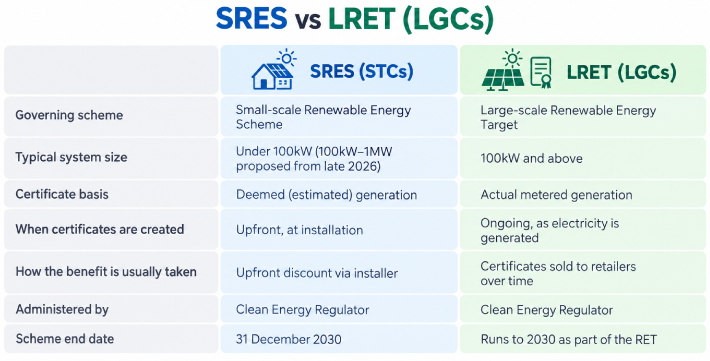
| SRES (STCs) | LRET (LGCs) |
|---|---|---|
Governing scheme | Small-scale Renewable Energy Scheme | Large-scale Renewable Energy Target |
Typical system size | Under 100kW (100kW–1MW proposed from late 2026) | 100kW and above |
Certificate basis | Deemed (estimated) generation | Actual metered generation |
When certificates are created | Upfront, at installation | Ongoing, as electricity is generated |
How the benefit is usually taken | Upfront discount via installer | Certificates sold to retailers over time |
Administered by | Clean Energy Regulator | Clean Energy Regulator |
Scheme end date | 31 December 2030 | Runs to 2030 as part of the RET |
Which Scheme Applies to Your Business?
Start with your system’s total onsite capacity. The Clean Energy Regulator’s “device” rules can combine multiple arrays behind one meter into a single system, or treat separately metered systems as distinct devices, so the answer isn’t always as simple as adding up panel wattage.
How to Check Which Scheme Applies
- Confirm total onsite capacity from your installer’s system design, not panel nameplate wattage
- Under 100kW: SRES and STCs apply
- 100kW or above today: LRET and LGCs apply
- 100kW–1MW, installing later in 2026: ask if the SRES expansion has come into force
- 1MW or above: LGCs apply regardless
- Get written confirmation of which scheme your quote assumes
If you’re weighing up a system near the 100kW mark, it’s worth talking to a solar consultant about timing before you sign a contract. See our 30kW, 50kW and 100kW commercial system pages for typical specifications at each size.

Key Takeaways
- Under 100kW: SRES, STCs, upfront and deemed
- 100kW and above: LRET, LGCs, based on actual metered generation
- A proposed expansion would let 100kW–1MW systems create STCs from later in 2026, pending regulations
- Existing sub-100kW and already-accredited large-scale systems aren’t affected by the change
- Confirm current eligibility with your installer or the Clean Energy Regulator before finalising a system over 100kW