
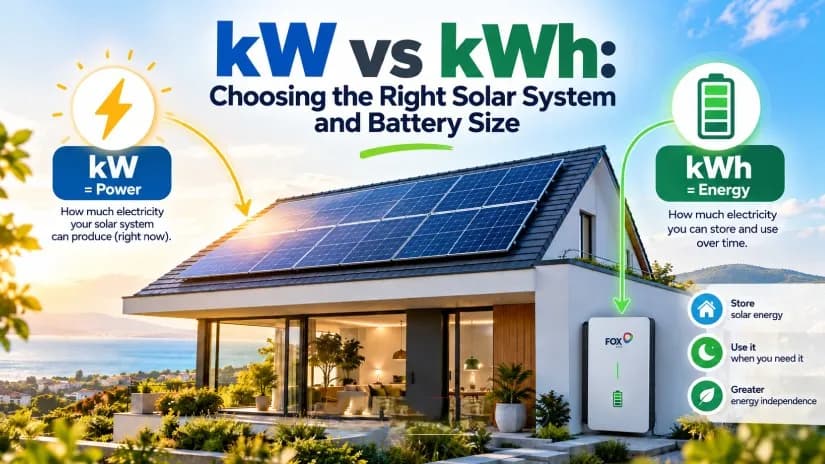
Quick answer: kW (kilowatt) measures power, the rate electricity flows at any moment. kWh (kilowatt-hour) measures energy, the amount used or stored over time. Solar systems are sized in kW, while your bill and your battery storage are measured in kWh.
kW vs kWh: What's the Difference?
The difference between kW and kWh is speed versus quantity: kW tells you how fast electricity is flowing, kWh tells you how much has flowed. One kilowatt running for one hour equals one kilowatt-hour. To convert kW to kWh, multiply the power by the hours it runs. A 2 kW heater left on for three hours uses 6 kWh.
Picture a garden hose filling a bucket. The kW is how hard the water is coming out of the hose. The kWh is how much water ends up in the bucket.
| kW (kilowatt) | kWh (kilowatt-hour) | |
|---|---|---|
| Measures | Power: the rate at one moment | Energy: the amount over time |
| On a solar quote | Panel array and inverter size | Expected daily generation |
| On a battery spec sheet | How much it can supply at once | How much it can store |
| On your bill | Rarely shown for homes | What you are charged for |
Where kW Appears on a Solar Quote
Most solar quotes show two kW figures, and they are rarely the same. The panel array size is the combined rating of every panel on the roof, for example 6.6 kW. The inverter size is the most AC power the inverter can send to your home and the grid, and on a 6.6 kW system it is often 5 kW.
That gap is deliberate. Panels rarely produce their full rating outside ideal conditions, so a slightly smaller inverter stays busy for more of the day. Industry design guidelines allow panel capacity of up to one-third more than the inverter. Your local network also limits inverter size and exports, and those limits can depend on whether your home has single-phase or three-phase power.
Where kWh Appears: Your Bill, Your Panels and Your Battery
kWh is the number that shows how much electricity you use and how much your panels make. On your bill, look for your average daily usage in kWh. Many bills also compare your use against an AER consumption benchmark for households of a similar size.
For generation, the Clean Energy Regulator gives postcodes in Sydney, Canberra, Brisbane, Adelaide and Perth a Zone 3 rating of 1.382 MWh per kW per year. That works out to roughly 3.8 kWh per kW per day across a full year. So a 6.6 kW system averages around 25 kWh a day, with more in summer and less in winter. Shading, roof direction and tilt move that figure up or down.
Battery Specs Need Both Numbers
A home battery has a kWh rating for how much it stores and a kW rating for how fast it can deliver that energy.
Storage is listed two ways. Nominal capacity is the total the cells can hold, usually the number on the product label. Usable capacity is what you can actually draw out, because the battery keeps a reserve to protect its cells. Compare batteries on usable kWh.
The kW rating decides what you can run at the same time. A battery with plenty of stored kWh but a modest continuous kW output may struggle to run an oven, a kettle and an air conditioner together, even when it is full. If blackout backup matters to you, ask for the continuous kW output and which circuits will be backed up. A hybrid solar system brings panels and battery under one inverter.
What Size Solar System Do I Need? Start With Your kWh
To answer "what size solar system do I need?", start from your daily kWh, not a kW figure someone mentioned. A quick estimate for Zone 3 homes:
- Find your average daily usage in kWh across your last few bills.
- Divide it by 3.8, the Zone 3 daily average from above.
- Round up to the nearest common system size, then check your roof space.
A household using 22 kWh a day gets 22 ÷ 3.8 ? 5.8 kW, which points to a 6.6kW solar system. A home using 35 kWh a day lands near 9.2 kW, closer to a 10kW solar system, and bigger users may look at a 13kW solar system. Solar only produces in daylight, so covering evening use needs a battery. Our 6.6kW vs 10kW comparison goes further into the trade-offs.
Using kWh to Size Your Battery
Size a battery on the kWh you use after the sun goes down, not your whole daily total. If your retailer app or smart meter data shows about 12 kWh used between late afternoon and morning, a battery with roughly that much usable capacity will cover most nights, as long as your panels make enough spare energy to fill it.
Why Usable kWh Decides Your Federal Battery Rebate
The federal battery discount is calculated on usable kWh, so this number affects your price as well as your storage. The Cheaper Home Batteries Program pays the discount as small-scale technology certificates (STCs). For batteries installed from 1 May to 31 December 2026, each usable kWh earns 6.8 STCs, tapered by battery size:
- First 14 kWh of usable capacity: 100% of the STC factor
- Above 14 kWh, up to 28 kWh: 60%
- Above 28 kWh, up to 50 kWh: 15%
- Above 50 kWh: no STCs
| Usable capacity | Approx. STCs (May–Dec 2026) | Solar Junction option |
|---|---|---|
| 14 kWh | About 95 | 14kWh solar battery system |
| 28 kWh | About 152 | 28kWh solar battery system |
| 42 kWh | About 166 | 42kWh solar battery system |
Capacity above 28 kWh earns far less, so a battery much larger than your overnight use gives a smaller discount per extra kWh. The dollar value depends on the STC price at the time, and your installer applies it as an upfront discount.
Eligible batteries must be 5 to 100 kWh in nominal capacity and installed with a new or existing solar system. Per the Clean Energy Regulator STC factor table, the factor falls to 5.7 for batteries installed.

Key Takeaways
- kW is power at a moment; kWh is energy over time.
- Size solar from your daily kWh. In Zone 3, divide by about 3.8.
- Size a battery from your evening and overnight kWh.
- Compare batteries on usable kWh and continuous kW output.
- The federal battery discount is worked out per usable kWh and steps down on 1 January 2027.