
Quick Answer
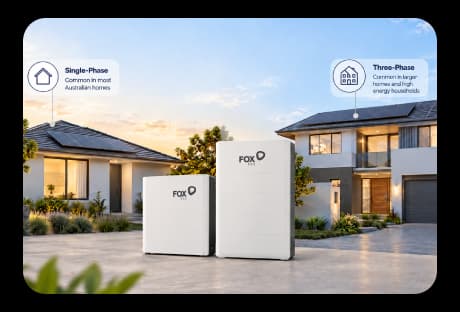
Your home’s phase type doesn’t stop you from adding a battery. It decides which inverter suits your property, how much of the house you can back up in a blackout, and how much solar you can export to the grid. Most Australian homes are single-phase. Three-phase is more common in larger homes, rural properties, and homes with heavy loads like ducted air conditioning, workshops or EV chargers.
What’s the Difference Between Single-Phase and Three-Phase Power?
Single-phase power reaches your home through one active wire and a neutral, delivering 230V. It’s the standard setup for most Australian houses and units, and it’s enough for typical appliances plus a standard rooftop solar system.
Three-phase power uses three active wires and a neutral, delivering 400V across the phases. It’s common in larger or newer homes, rural properties, and anywhere with heavy electrical demand. Because the load splits across three wires instead of one, three-phase generally supports bigger systems and heavier appliances without overloading the supply.
Not sure which one you have? Check your switchboard or main meter. One incoming active wire usually means single-phase; three usually means three-phase. Your distributor can also confirm this.
How Your Phase Type Affects Battery Choice and Backup
Two things actually change with phase type. First, blackout backup. A single-phase battery installed on a three-phase home typically only backs up the one phase it’s wired into, not the whole house, unless the system is specifically designed for three-phase backup.
Second, inverter compatibility. In most modern systems, it’s the hybrid inverter that decides whether a setup is single-phase or three-phase, not the battery. FoxESS, a brand Solar Junction installs, makes single-phase (H1) and three-phase (H3) hybrid inverters that pair with the same family of FoxESS battery modules. Battery capacity usually isn’t the limiting factor — inverter choice is.
Native three-phase battery-inverter units are also starting to appear on the Australian market. Availability is still changing, so confirm current options with your installer.
Single-Phase vs Three-Phase for Battery Storage
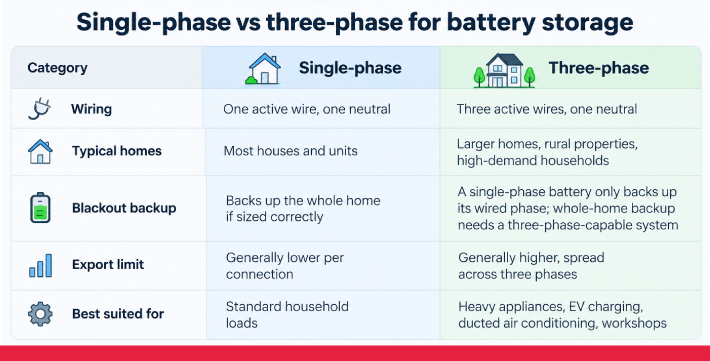
Feature | Single-phase | Three-phase |
|---|---|---|
Wiring | One active wire, one neutral | Three active wires, one neutral |
Typical homes | Most houses and units | Larger homes, rural properties, high-demand households |
Blackout backup | Backs up the whole home if sized correctly | A single-phase battery only backs up its wired phase; whole-home backup needs a three-phase-capable system |
Export limit | Generally lower per connection | Generally higher, spread across three phases |
Best suited for | Standard household loads | Heavy appliances, EV charging, ducted air conditioning, workshops |
Export Limits: Why There’s No Single National Number
Every solar and battery system has a grid export limit set by your local electricity distributor, not by Solar Junction or the manufacturer. These limits genuinely vary by state and network, and some are shifting toward flexible export arrangements rather than one fixed cap. Because the figures differ and change, we won’t quote a national number here — your installer will confirm the exact limit for your address under the current AS/NZS 4777 inverter connection standard as part of your quote.
How to Work Out What Your Home Needs
- Check your switchboard to confirm whether you currently have single-phase or three-phase power.
- Think about future loads. An EV charger, ducted air conditioning, a pool pump or a workshop can push a single-phase supply toward its limit.
- Decide how important whole-home backup is, and factor that into your inverter selection before installation, not after.
- Get a proper site assessment — your supply, roof and usage matter more than a generic online calculator.
Key Takeaways
- Most Australian homes are single-phase; three-phase suits larger or high-demand properties.
- Phase type mainly affects backup coverage and inverter choice, not whether you can have a battery.
- The hybrid inverter, not the battery, usually decides single-phase vs three-phase.
- Export limits are set by your distributor and vary by state — confirm yours.
- Tell your installer upfront if whole-home backup matters, so they can design for it.