Massive Battery Savings Have Landed Claim Yours Today!

Monocrystalline vs. Polycrystalline Solar Panels: Is There Still a Difference for Australian Roofs?
HOME > Monocrystalline vs. Polycrystalline Solar Panels: Is There Still a Difference for Australian Roofs?

Short Answer: If you’re wondering monocrystalline or polycrystalline which is better, the answer for most Australian homes in 2026 is clear; monocrystalline panels.
The gap between monocrystalline vs polycrystalline solar panels has narrowed significantly by 2026. Monocrystalline panels now dominate due to better efficiency, improved performance, and similar pricing. Polycrystalline panels still exist but are rarely used for residential rooftops in Australia today.
Even in 2026, homeowners continue searching for monocrystalline vs polycrystalline solar panels because older information online suggests major differences in cost and performance.
The reality is that the solar market has evolved. Manufacturing improvements, better cell technology, and large-scale production have shifted the industry heavily toward monocrystalline panels.
Still, understanding the difference between monocrystalline and polycrystalline. There are many solar panel types helps homeowners make informed decisions, especially when comparing older systems or budget-focused quotes.
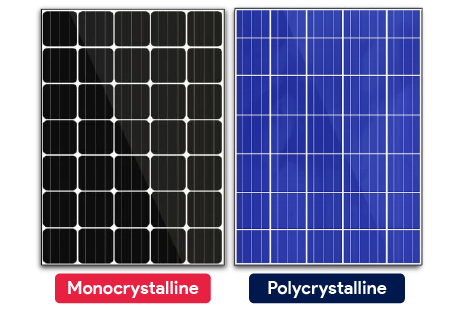
The difference between monocrystalline and polycrystalline solar panel types comes down to how the silicon cells are made.
Quick Comparison Table
|
Feature |
Monocrystalline |
Polycrystalline |
|
Efficiency |
Higher |
Lower |
|
Appearance |
Black, uniform |
Blue, speckled |
|
Space Required |
Less |
More |
|
Lifespan |
Longer |
Slightly shorter |
|
Availability in Australia |
Widely used |
Limited availability |
This is the core difference between monocrystalline and polycrystalline solar panel types today, but the gap has become more pronounced over time in favour of mono technology.
Polycrystalline panels are not completely gone, but they are rarely recommended for residential use.
For typical homeowners, the monocrystalline vs polycrystalline solar panels decision is no longer balanced, mono is now the default.
Mass production has made monocrystalline panels far more affordable than before.
Labour, mounting, and electrical work remain identical regardless of panel type.
When comparing monocrystalline vs polycrystalline solar panel price, the overall system cost difference is often negligible.
Panel price is only one part of the total system cost; and today, that gap is small enough that efficiency matters more.
When comparing monocrystalline vs polycrystalline solar panels efficiency, modern mono panels clearly perform better; especially in Australia’s climate.
Older assumptions that poly panels were “good enough” no longer hold true for modern systems.
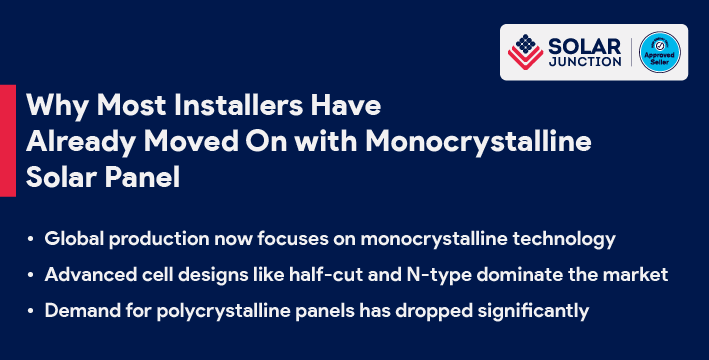
The shift in the industry is already complete.
This is why the monocrystalline vs polycrystalline solar panels debate is becoming less relevant; the industry has already chosen a direction.

In 2026, the comparison between monocrystalline vs polycrystalline solar panels is no longer about trade-offs.
Technology improvements and pricing changes have made monocrystalline panels the standard choice for residential rooftops solar system in Australia. Because they do not any kind of leak or damage your rooftop. While polycrystalline panels still exist in limited scenarios and longer a mainstream option for homeowners seeking efficiency, performance, and long-term value.
Yes, their usage is declining rapidly as manufacturers shift toward more efficient monocrystalline technologies.
Yes, modern mono panels handle heat more efficiently, making them better suited for Australian conditions.
No, the monocrystalline vs polycrystalline solar panel cost gap has reduced significantly.
Monocrystalline panels generally have a longer lifespan and better long-term performance.
If upgrading your system, switching to monocrystalline panels is usually the better long-term choice.

Higher rebates available
only until 30 April 2026