
Quick answer: The NSW commercial battery rebate is a new incentive called BESS4, rolling out under the state’s Peak Demand Reduction Scheme on 1 September 2026. Businesses installing a battery with usable capacity between 20kWh and 200kWh can generate Peak Reduction Certificates worth a share of the installation cost. It’s not a fixed cash payment — the value depends on the battery’s technical design and the certificate market at the time.
What Is the NSW Commercial Battery Rebate (BESS4)?
BESS4 is a new activity under the NSW Peak Demand Reduction Scheme (PDRS), administered by IPART under the Peak Demand Reduction Scheme Rule. New / upcoming official commencement date confirmed as 1 September 2026.
The PDRS already covers a range of household and business measures aimed at cutting electricity demand during peak periods. BESS4 extends it to small and medium business batteries for the first time. It sits alongside two other new battery activities starting the same day: BESS3, for apartment buildings, and BESS5, for larger commercial and industrial batteries.
A business qualifies for BESS4 based on the size of the battery installed, not its industry. Usable capacity has to sit above 20kWh and no higher than 200kWh a range that covers most SME-scale installations, from a single warehouse battery to a modest manufacturing site setup.
How the BESS4 Incentive Actually Works
BESS4 doesn’t pay businesses a set incentive amount. Instead, an installation that meets the scheme’s requirements lets an Accredited Certificate Provider (ACP) create Peak Reduction Certificates, or PRCs, based on the battery’s technical design. Those certificates are then sold into a market, and the proceeds reduce what the business pays upfront for the system.
Because PRC prices move with the market, no two BESS4 projects generate exactly the same value. Some industry sources have estimated the incentive could offset somewhere between 20% and 50% of an installed system’s cost, based on recent certificate prices.
That figure comes from private industry commentary, not a government source, so it’s included here as context only treat it as a rough guide until a project-specific quote confirms the real number.
The certificate scheme also means the incentive isn’t claimed directly by the business. The installer or their ACP partner handles the certificate creation and sale as part of the project, and the saving is typically reflected in the quoted price.
BESS3 vs BESS4 vs BESS5: Which One Applies to Your Business?
All three activities commence on 1 September 2026 and work the same way certificates rather than a fixed incentive — but they’re scoped to different kinds of sites.
Activity | Who it's for | Usable battery capacity | Status |
|---|---|---|---|
BESS3 | Apartment buildings (4+ dwellings) | 20kWh–200kWh | New — from 1 Sept 2026 |
BESS4 | Small and medium businesses | 20kWh–200kWh | New — from 1 Sept 2026 |
BESS5 | Larger commercial, industrial and community sites | 200kWh–30MWh (incentive applies to the first 10MWh) | New — from 1 Sept 2026 |
For most Solar Junction commercial customer’s warehouses, manufacturing sites and cold storage facilities under 200kWh of battery capacity BESS4 is the relevant activity. Larger sites planning a system above 200kWh should ask about BESS5 instead.
Is Your Business Eligible for BESS4?
A project needs to meet all of the following to qualify. This list is based on current industry reporting of the scheme requirements and should be confirmed against the final PDRS Rule wording before a quote is finalised.
- The site is a business, commercial or industrial premises not a residential building.
- The site is not a data centre (data centres are excluded from BESS4 and BESS5).
- The site hasn’t already received a BESS4 or BESS5 incentive in the past.
- The battery’s usable capacity is greater than 20kWh and no more than 200kWh.
- The battery equipment is CEC-listed.
- Installation is carried out by an SAA-accredited installer.
- A minimum $5000 per implementation co-payment applies to the project.
Talk to Solar Junction about a project-specific eligibility check before committing to a system design
Do You Need to Install New Solar as Well?
No. Solar isn’t compulsory for BESS4 a battery can be installed on its own and still qualify. That said, projects that pair a new battery with new solar generation typically move into a higher incentive tier, since the combined system does more to shift demand away from peak periods. For businesses already weighing up a battery, it’s worth asking for pricing on both a battery-only and a combined solar-and-battery option before deciding.
This applies whether a business already has solar and is adding a battery to an existing system, or is starting from scratch with a full commercial solar and battery package.
Can BESS4 Be Combined with the Federal Cheaper Home Batteries Program?
Possibly. Small business battery systems under 100kWh may also be eligible for the federal Cheaper Home Batteries Program, which is a separate incentive delivered through the Clean Energy Regulator. Combining both schemes on one eligible project could meaningfully cut the upfront cost, but eligibility depends on the specific site and system design — this needs to be checked project by project rather than assumed.
Which NSW Businesses Stand to Benefit Most from BESS4?
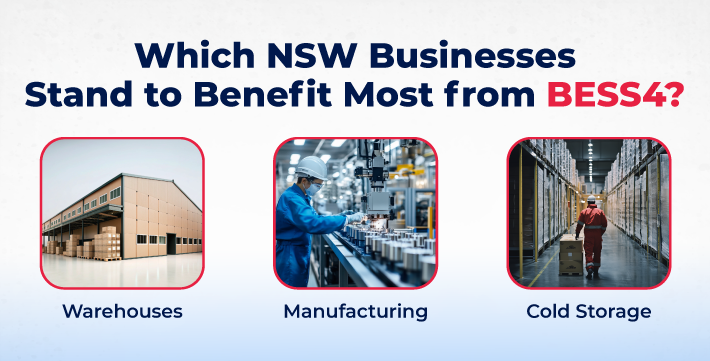
BESS4 doesn’t restrict eligibility by industry, but three types of commercial sites tend to get the strongest case for a battery:
- Warehouses — refrigeration, forklift charging and HVAC load create sharp demand peaks that a battery can smooth out.
- Manufacturing — predictable, high daytime electricity use makes it easier to size a battery against actual consumption.
- Cold storage — continuous refrigeration load means backup power isn’t just a cost saving, it’s a safeguard against stock loss during an outage.
If your business falls into one of these categories, a commercial solar and battery assessment is the fastest way to see what BESS4 could be worth for your specific load profile.
When Does BESS4 Start, and What Should You Do Now?
Eligible battery installations need to occur on or after 1 September 2026 to qualify for BESS4. There’s no confirmed end date for the activity at this stage availability and eligibility can change, so this guide will be updated if that changes.
Businesses don’t need to wait until launch day to start the process. Site assessments, system design and quoting can happen now, so a project is ready to proceed as soon as the scheme opens. Given certificate values move with the market, getting a design finalised early also means less uncertainty about the numbers by the time installation happens.

Key Takeaways
- BESS4 is a new NSW incentive for business batteries between 20kWh and 200kWh usable capacity, starting 1 September 2026.
- It delivers value through tradeable Peak Reduction Certificates, not a fixed dollar rebate.
- Solar isn’t required, but pairing a battery with new solar typically increases the incentive.
- BESS4 may be able to be combined with the federal Cheaper Home Batteries Program for systems under 100kWh.
- Warehouses, manufacturing and cold storage sites are strong candidates given their load profiles.
- Eligibility details in this guide should be confirmed against the final PDRS Rule before a project is finalised.
Get a BESS4 Eligibility Check for Your Business
Every site is different, and the real incentive value depends on your battery size, load profile and project design. Speak with Solar Junction’s commercial team for a project-specific BESS4 assessment — call 1300 345 365 or request a commercial solar and battery quote online.